Monkey: Journey to the West

Filed under: 2008 — brian at 2:11 pm on Wednesday, May 28, 2008

By Jeffrey Day

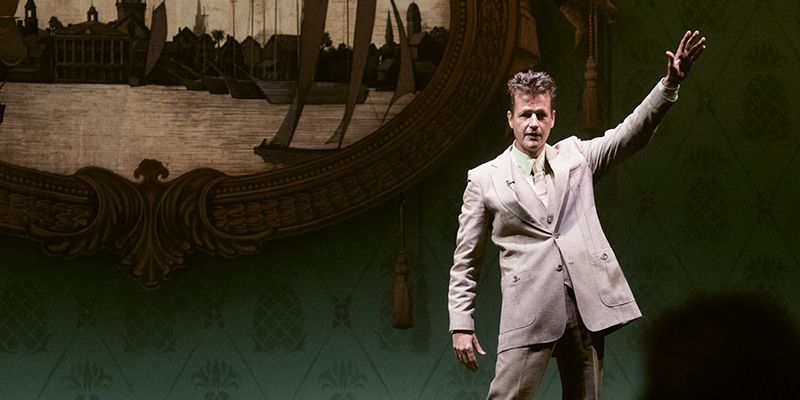
The new musical theater work at the Spoleto Festival, Monkey: Journey to the West, is a lot like the feisty, funny jungle creature for which it’s named. With its elaborate costumes and sets, video projects, varied music, flying acrobats, and kung fu-like fighting, Monkey is almost too much to contain in Sottile Theatre, where it made its U.S. premiere.
monkey_62.jpg
Based on an ancient Chinese story, Monkey was created by director and writer Chen Shi-Zheng, as well as composer Damon Albarn of the band Blur and animator and designer Jamie Hewlett, who both created the “virtual” rock group Gorillaz. Chen has directed both western and Chinese operas (including The Peony Pavilion and The Flying Dutchman at Spoleto). The group has pooled its talents, along with those of expert choreographers and musicians, to create a unique musical theater production.

The story follows the Monkey King in his quest for immortality. A real anti-hero, Monkey is loud, mean, and self-centered—he also scratches his crotch a great deal. Along the way, he gets imprisoned by the giant hand of the Buddha then bounces back when he’s chosen to be Tripitaka’s bodyguard. After setting off to India, where Tripitaka has some sacred texts to pick up, the two run into trouble along the way. Joined by some of their adversaries (a flesh-eating monster and a pig) they face dragons, demons, and a hot spell.

The music, a mix of east and west, classical and rock, is elaborate and intense. At times, a barrage of sound pours from the speakers, at others small sections of the orchestra are featured in moments.

Among the most amazing is an underwater scene where fish glide through the water. In another, the guardians of a sacred orchard float above the trees, singing serenely. A spider woman and her sisters do an elaborate dance in the air hanging on to long red banners. The downside? Every scene, no matter how beautiful, ends in a big battle. For all of its magic, the show would be considerably stronger if it ran 90 minutes rather than 120. How many acrobatic fight scenes does the audience really need?

Don’t look to Monkey for any deep Buddhist lessons, as this show is nearly all action. The pure physical spectacle is stunning, but a bit more philosophy would be welcome.

Monkey: Journey to the West continues through June 8.

The Opening Weekend

Filed under: 2008 — brian at 10:25 am on Wednesday, May 28, 2008

By Jeffrey Day

One of the biggest changes this year in Spoleto Festival USA is the relocation of the Chamber Music Series to newly renovated Memminger Auditorium from the being-renovated Dock Street Theatre. As folks entered Memminger for the first weekend of concerts, many could be heard reminiscing about the Dock Street in the same loving manner Charles Wadsworth, host of the series, is typically praised.

And though Memminger isn’t yet perfect—if someone drops a program book or taps a foot too hard, the seats risers echo; the air conditioner audibly hums but doesn’t interfere too much; and the house lights being up during concerts causes distraction—there’s also plenty to love about the new space. Most importantly, the house doesn’t swallow up the music. It sounds rich and full, with both the low and high notes and the dynamics among the instruments fully audible. At 11 a.m. and 1 p.m. each day, the hall is divided in half for the chamber series concerts. It holds only 15 more people than Dock Street but has a lot more open space and seating that’s less cramped. (There were a surprising number of empty seats during two concerts this first weekend.)

Despite the favorable acoustics, during Friday’s opening concert, Wadsworth’s rambling pre-concert comments couldn’t be heard that well. Fortunately, this year he is joined by a co-host and co-coordinator of similar charm who can be heard: Geoff Nuttall, principal violinist for The St. Lawrence String Quartet.

The first concert consisted of a sonata by Francis Poulenc, Ralph Vaughan Williams’ On Wenlock Edge, and Ernö Dohnányi’s Sextet in C Major. The highlight was the last piece, originally commissioned for a very odd mix of instruments—piano, violin, viola, horn, cello, and clarinet. Along with festival regulars such as Nuttall, Stephen Prutsman (piano), and Alisa Weilerstein (cello), newcomers Hsin-Yun Huang (viola) and Eric Ruske (horn) turned out a perfect performance.

Another newcomer to the series, tenor Paul Groves lent a big voice to the proceedings. He nailed the Williams tunes in the first concert, and shook the rafters in the second. His rendition of four songs by Fritz Kreisler amazed. “These are like opera in their subject matter: ‘I love you, I hate you, you killed my brother,’” said the performer before letting loose his beautiful voice in perfect harmony with Nuttall. Groves hit all the notes and all the emotions of the songs.

This concert opened with an early work by Samuel Barber that Weilerstein performed with her usual intensity and technical proficiency. To hear the rarely performed cello sonata played so well was likely a once-in-a-lifetime experience.

At the Gaillard, the Boston Ballet made a heck of a return after its previous appearance at Spoleto in 1989. Since becoming artistic director to the company in 2001, Mikko Nissinen has transformed the group, and this weekend’s performances illustrated the ballet’s diversified talents.

For the traditionalists, the company beautifully performed several excerpts from Swan Lake. For those fans of modern and post-modern, there was Twyla Tharp’s In the Upper Room. The piece, with music by Philip Glass, was full of energy and an excellent melding of modern, pop, and contemporary moves. For the rest of us, the ballet performed Brake the Eyes, a 2007 piece by resident choreographer Jorma Elo. The performance began with humming and strange murmuring from a robot-like dancer who moved in an odd, mechanical way. The piece then transitioned into the classical realm with music by Mozart. And so it went, back and forth, each section becoming shorter and shorter until the murmuring, movements, and Mozart all began to overlap. Brake the Eyes was engaging on every level imaginable. Let’s hope the Boston Ballet makes a return before another 20 years passes.

Also on the dance program this weekend was traditional Indian dancer Shantala Shivalingappa and her troupe of musicians. While there’s no denying that their performance was mesmerizing—she’s a great dancer and they’re great players—pure Indian dance and music didn’t quite seem a good fit for Spoleto. The show felt more like an educational program aimed at introducing audiences to Indian dance and music than an arts festival performance. It even came with recorded introductions to each piece. For the uninitiated, a little of this music and dance went a long way. For those already familiar, it didn’t bring anything new to the art form.

La Cenerentola

Filed under: 2008 — brian at 10:25 am on Wednesday, May 28, 2008

By Jeffrey Day

Those who have attended Spoleto Festival USA in the past five years may have had the pleasure of seeing director Charles Roubaud’s delightful productions of the operas Lakme and Ariadne aux Naxos. After a couple years away, he’s back with the smart, stylish, and nearly perfect sounding La Cenerentola.

Gioachino Rossini’s 1817 comic opera isn’t quite the Cinderella story that most of us grew up with (there’s no stepmother, fairy godmother, or glass slipper), but it is every bit as engaging with princes in disguise and a kind of tutor/wizard, as well as an earthquake. The rich and colorful music is also expertly performed under Matteo Beltrami, who makes his festival debut. The opening night crowd seemed to love the newcomer, giving him a post-intermission volley of applause that’s rarely heard.

Another onstage performer earned well-deserved praise—Sandra Piques Eddy in the title role. Wanting to hear and see more of the mezzo-soprano after her performance as the maid in Lakme, I felt lucky to listen to her sing in one of the few leading roles on Friday night. Eddy has done wonderful things with the character, who is strong and feisty, never a victim. She stands out in an almost uniformly superior group of actor-singers who are capable of bringing great emotion as well as humor to the opera.

Among the cast are bass Paolo Pecchioli as the tutor; baritone Tim Nolen as the evil stepfather; and baritone Bruno Taddia, the prince’s valet, who spends most of the opera impersonating his master in a plot to find the prince a suitable wife. However, tenor Victor Ryan Robertson, who plays the prince, is surprisingly weak in comparison to what’s admittedly a nearly perfect cast. The highly physical roles, at times bordering on slapstick, are amazing. I wondered how they could keep on singing so well while literally bang heads.

Unlike Lakme and Ariadne, La Cenerentola is not a fanciful staging. The elaborate set—with huge columns, giant archways overlooking the garden, and towering wooden walls with oversize artworks—in most ways feels almost real. Costumes are simple and subdued. The lighting moves from high realism to magic. Nothing needs to be tarted up. And all of this works well, because the comic antics take place in the score, libretto, and acting. The production also includes video projections that are often humorous, blending real scenes with animation, and work well, except during the prince’s aria, when the comedy undercuts the opera’s serious side.

All in all, La Cenerentola is one of the best of the traditional stagings that Spoleto has produced in recent years.

The final performance is June 6 at Gaillard Auditorium.

Between the Devil and the Deep Blue Sea

Filed under: 2008 — brian at 10:24 am on Wednesday, May 28, 2008

By Jeffrey Day

The new British theater group 1927 possesses a great deal of imagination, but its first outing at Spoleto Festival USA, Between the Devil and the Deep Blue Sea, showed a company that may be too young to tap in to such talent. The four-member group, comprised of two actors, a pianist/singer, and an animator/video manipulator, created this 10-act, 50-minute piece with brilliant moments, some dead ends, and a lot of repetition. These mostly dark tales—including a cat losing its nine lives, terrible things transpiring in the suburbs, and children killing playmates—reminded me of Monty Python skits, though they weren’t nearly as well written.

With flights of fancy into adolescent surrealism, macabre humor, and a recurring tilt toward the sadistic that became downright irritating, the writing was the downfall of the performance. The stories were told in a straightforward narration, mostly by writer, director, and actor Suzanne Andrade, who joined primary actress Esme Appleton from time to time. Still there wasn’t much acting involved, since there was little dialogue. The piano playing and occassoinal singing by Lillian Henley did add something, but not enough.

Besides, the real star isn’t on stage—in the back of the theater, Paul Barritt ran his the whimsical and wonderful animations, which provided a backdrop for the actors, who appeared to be part of the drawings. If only he had better writing to work with, this would have been a truly terrific show.

Between the Devil and the Deep Blue Sea has completed its run.

Next Page »